Honestly it depends more than people admit.
If you search this topic online, most articles say the same thing. SaaS ERP is flexible. On-premises ERP gives control. Cloud is the future. Traditional systems are old school.
Choosing an ERP system is one of those decisions that sounds technical, but it affects almost everything. Your accounts team uses it. Your sales team uses it. Operations depends on it. And if the system is slow, confusing, or expensive, everybody complains.
Let’s talk about it in real terms.
Let’s Talk About Money First-Because Everyone Does.
SaaS ERP is easier to start with:
Usually, SaaS works on subscription i.e. monthly, quarterly, yearly. That means you’re not spending a huge amount in one go. For smaller businesses, this feels safer less commitment, less pressure. Kind of like Netflix, except far more expensive and less entertaining.
On-premises can hit hard upfront:
This one usually comes with bigger first costs – licenses, hardware, setup, IT support and sometimes those one-time costs somehow keeps happening again and again. You fix one thing, another thing breaks. You upgrade one server, now something else needs updating. That’s business life.
Long-term? It gets blurry:
People love saying SaaS is cheaper – sometimes it is, sometimes it isn’t. Subscriptions add up over years. On-premises costs a lot first, then less later unless maintenance starts becoming a monster. So there’s no universal answer here.
Can Your Team Actually Use It Without Complaining?
SaaS ERP works from basically anywhere:
Office, home, airport, client site. If there’s internet, there’s access. That’s a huge plus now because remote work is normal and even companies that say they don’t do remote work somehow still do remote work.
On-premises ERP can be customized more:
Some businesses are simple others are chaos and I mean that respectfully. Maybe your workflow has ten approval levels, maybe your inventory system is weird, maybe your billing process was designed in 2009 and nobody wants to change it. On-premises systems can usually bend more to fit that.
Growth is easier with SaaS:
Need more users? Need more storage? Need another branch connected? Usually easier. With on-premises, growth sometimes means buying more machines, more setup, more ‘we will handle it next week’ and ‘next week’ becomes next month.
Security: The Part Everyone Gets Serious About.
SaaS providers handle a lot for you:
Backups, security patches, system updates. A good provider usually handles this automatically. Which saves time, stress and random midnight calls.
On-premises gives more control:
A lot of companies like that especially if they deal with sensitive data or compliance or they simply don’t trust third parties. Fair enough. Having control feels safe. Even if it also means more responsibility.
Maintenance becomes your problem:
And this gets ignored too often, servers fail, systems lag, updates cause bugs. Things happen. If you’ve got a strong IT team, okay. If not good luck.
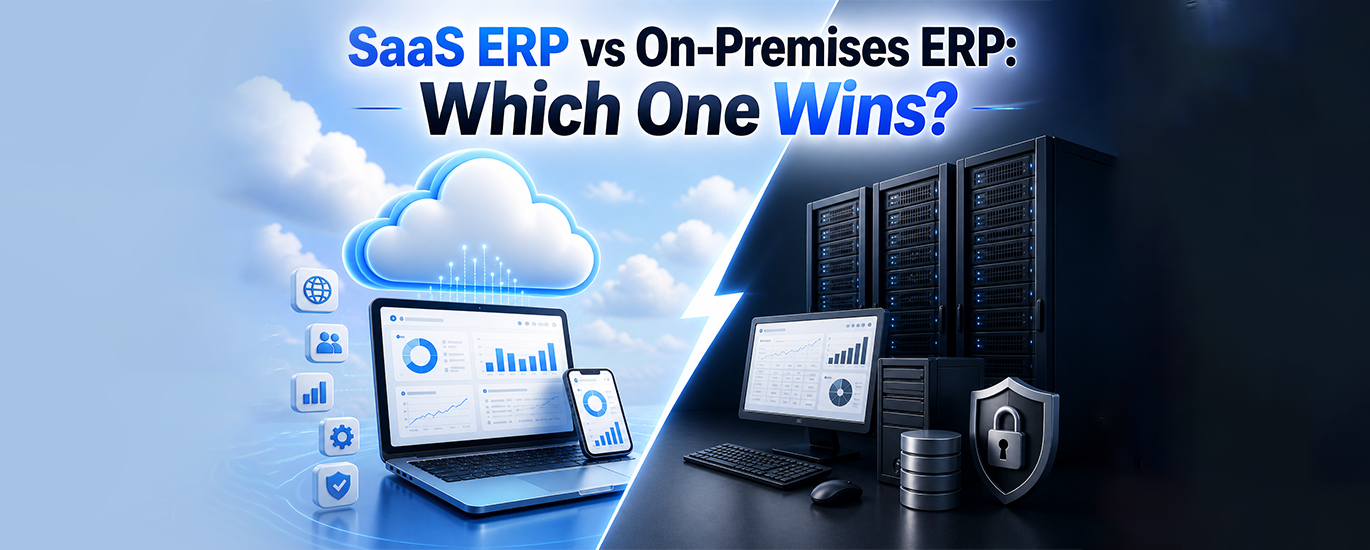
Conclusion: So Which One Wins?
The boring answer? Neither.
The practical answer?
Whichever one fits your business without creating daily frustration. If you want quick setup, flexibility, easier scaling, and less technical work – SaaS ERP probably makes more sense.
If you want full control, deeper customization, and you’ve got the team to maintain it on-premises may still be the smarter move. A lot of businesses chase trends. ‘Move to the cloud, digital transformation, modernize.’ Sounds great in meetings. But trends don’t fix operational problems. The right ERP does. And honestly? The best ERP system is the one your team barely complains about. That’s usually the real sign you picked well.